Real-Time Stats Overlays Reshaping Ranked Play in Live Dealer Online Poker Environments
Morgan Griffin · Aug 25, 2026
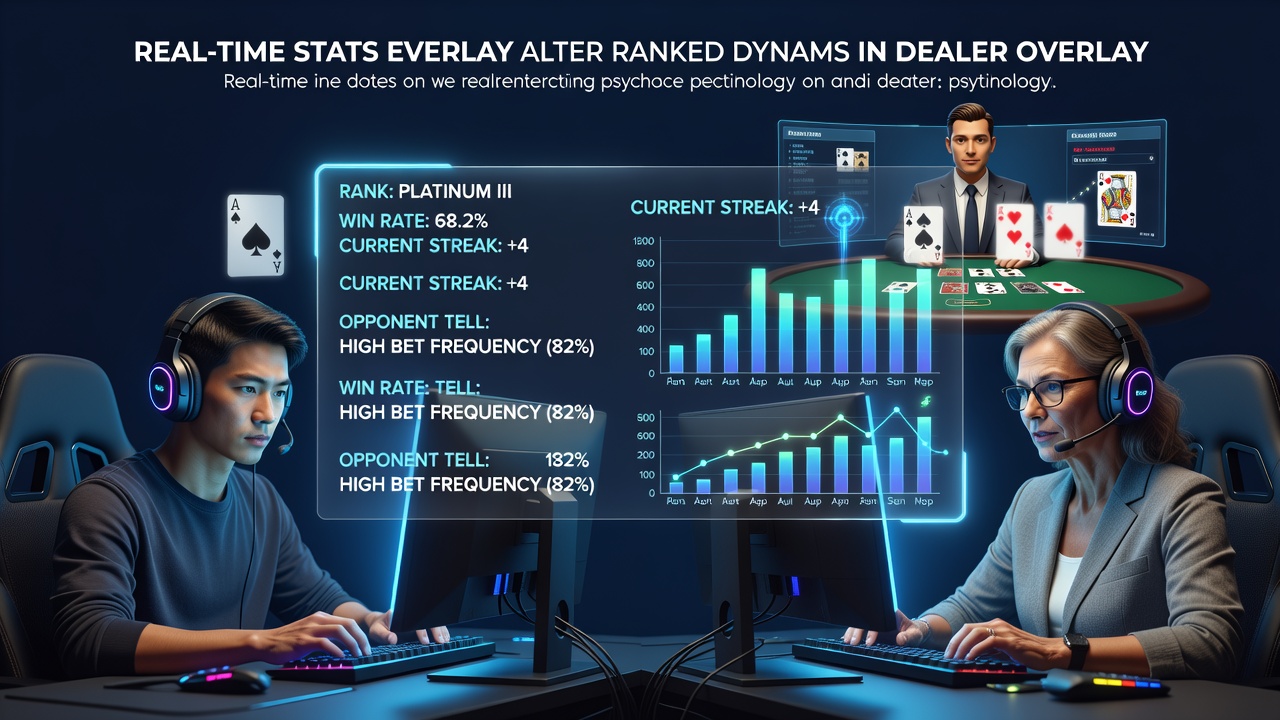
Real-Time Stats Overlays Reshaping Ranked Play in Live Dealer Online Poker Environments
Real-time stats overlays have become a standard feature across many dealer-mediated online poker platforms where live video feeds combine with digital tracking systems to deliver instant performance data to ranked participants. These tools pull from hand histories and opponent profiles to display metrics such as voluntary put money in pot percentages, aggression factors, and fold frequencies directly on screen during active play. Observers note that this integration allows players to adjust decisions within seconds rather than relying solely on memory or manual note-taking systems.
Platforms offering live dealer formats have seen increased adoption of these overlays since the expansion of cross-border tournament circuits in 2025, with further refinements appearing ahead of major events scheduled for August 2026. Data from regulated markets indicates that participants in ranked leaderboards now incorporate overlay information into pre-flop and post-flop choices at higher rates than in previous years. This shift occurs because the overlays update continuously as new hands are dealt, creating a feedback loop that influences betting patterns and table image management.
Platform Mechanics Behind Overlay Deployment
Dealer-mediated environments rely on video streams from physical tables paired with software layers that capture card data through optical recognition or direct input. Once a hand concludes, the system processes outcomes and feeds updated statistics into the overlay interface visible only to the individual user. Researchers at institutions tracking digital gaming patterns have documented how these layers maintain separation between the live dealer interaction and the statistical display, ensuring compliance with platform rules while still providing ranked competitors with actionable intelligence. The process runs in parallel to standard game flow, which means decisions must still occur within standard time banks yet now include an additional data stream to evaluate.
Effects on Decision Speed and Aggression Levels
Ranked participants report that access to real-time metrics changes how they approach marginal spots, particularly when facing unknown opponents in multi-table events. Instead of defaulting to conservative lines, many adjust raise sizes or continuation bet frequencies based on displayed fold-to-three-bet rates or river calling tendencies. Figures from industry reports compiled by the Australian Institute of Criminology show measurable increases in average hands played per hour on platforms with active overlays compared to those without such features. This acceleration stems from reduced uncertainty, allowing players to execute reads faster while the dealer manages physical card distribution and player interaction.
Yet the same data reveals that aggression metrics do not rise uniformly across all player pools. Mid-tier ranked competitors tend to tighten ranges when overlays highlight strong opponent statistics, whereas top leaderboard holders leverage the information to apply targeted pressure against weaker profiles. The distinction emerges because elite participants often maintain larger sample sizes from prior sessions, enabling them to interpret overlay outputs with greater context.

Shifts in Table Dynamics and Ranking Implications
Competitive balance within ranked formats experiences subtle recalibration when overlays become widely available. Newer entrants to leaderboards gain quicker access to historical patterns that previously required hundreds of hours of manual tracking, narrowing the experience gap between veterans and rising competitors. At the same time, established players adapt by altering physical tells or timing tells that overlays cannot capture, focusing instead on exploiting gaps in the statistical models themselves. Data collected through European gaming oversight channels demonstrates that tournament fields in live dealer formats have grown more polarized in recent seasons, with overlay-equipped participants clustering toward the upper and lower ends of payout structures rather than distributing evenly.
One documented pattern involves increased three-betting from late positions when overlays flag high fold frequencies in the blinds, a tactic that gains efficiency because the information refreshes after every orbit. This adjustment propagates through the field as opponents notice the pattern and modify their own responses, creating iterative cycles of adaptation that unfold across multiple sessions. Platforms hosting August 2026 series have introduced optional overlay toggles for certain events, allowing organizers to study participation differences between enabled and disabled groups without altering core rules.
Regulatory and Technical Considerations
Regulated jurisdictions require that overlay systems do not interfere with the integrity of live dealer operations or provide unfair advantages outside the platform's approved parameters. Compliance frameworks emphasize audit trails for data accuracy and restrictions on sharing overlay outputs with other users. Those who have examined these systems across multiple regions observe that technical latency remains a key variable, since delayed updates can render certain metrics less reliable during fast-paced dealer rotations. Industry associations such as the European Gaming and Betting Association have published guidelines encouraging standardized testing protocols to verify that overlays function consistently across devices used by ranked participants.
Conclusion
Real-time stats overlays continue to integrate more deeply into dealer-mediated online formats, producing measurable changes in how ranked players process information and execute strategies. The combination of live dealer presence with digital metrics creates an environment where decisions incorporate both immediate visual cues and accumulated performance data. As platforms prepare for upcoming series in August 2026, the ongoing refinement of these tools shapes participation patterns and competitive outcomes across global player pools.